STLHE 2023 Poster Presentation
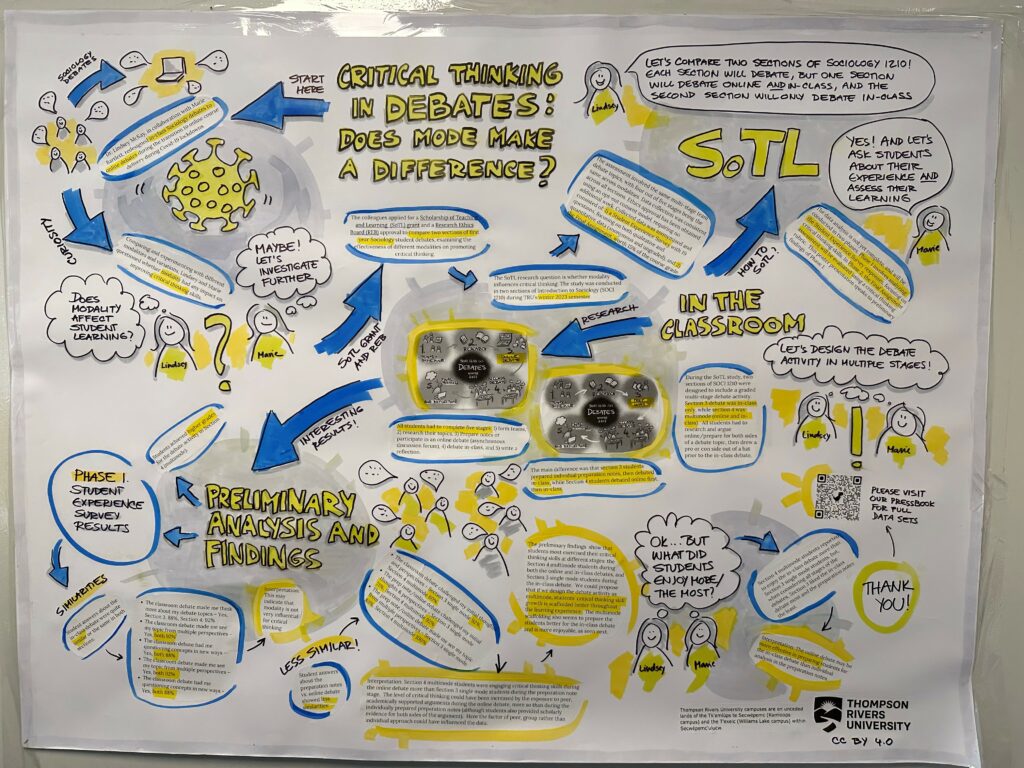
Critical Thinking in Debates: Does Mode Make a Difference?
Context:

Dr. Lindsey McKay, in collaboration with Marie Bartlett, redesigned in-class Sociology debates to online debates during the transition to online course delivery during Covid-19 lockdowns. Comparing and experimenting with different modalities and variations, Lindsey and Marie questioned whether modality had any impact on improving critical thinking skills. The colleagues applied for a Scholarship of Teaching and Learning (SoTL) grant and a Research Ethics Board (REB) approval to compare two sections of first year Sociology student debates, examining the effectiveness of different modalities on promoting critical thinking.

The Study:
The SoTL research question is whether modality influences critical thinking. The study was conducted in two sections of Introduction to Sociology (SOCI 1210) during TRU’s winter 2023 semester. The assessment involved the same multi-stage team debate topics, with four out of five stages being the same across modalities.
Data collection was consistent across all sections. Ethics approval has been obtained using an opt-out consent model, requiring no additional work. Collected data was anonymized and consisted of: 1) a Student Experience Survey with 19 questions, focusing on both qualitative and quantitative data (anonymous and ungraded), and 2) the Final Assignment, worth 15% of the course grade.
The data analysis is not yet complete, and will be conducted in two phases. Phase 1 involves analyzing the Student Experience Survey responses, focusing on critical thinking skills. In Phase 2, the Final Assignment assessment will be evaluated using a critical thinking rubric.
This poster presentation speaks to preliminary findings of Phase 1.
The Modalities
During the SoTL study, two sections of SOCI 1210 were designed to include a graded multi-stage debate activity. Section 3 debate was in-class only, while section 4 was multimode (online and in-class). All students had to research and argue online/prepare for both sides of a debate topic, then drew a pro or con side out of a hat prior to the in-class debate.
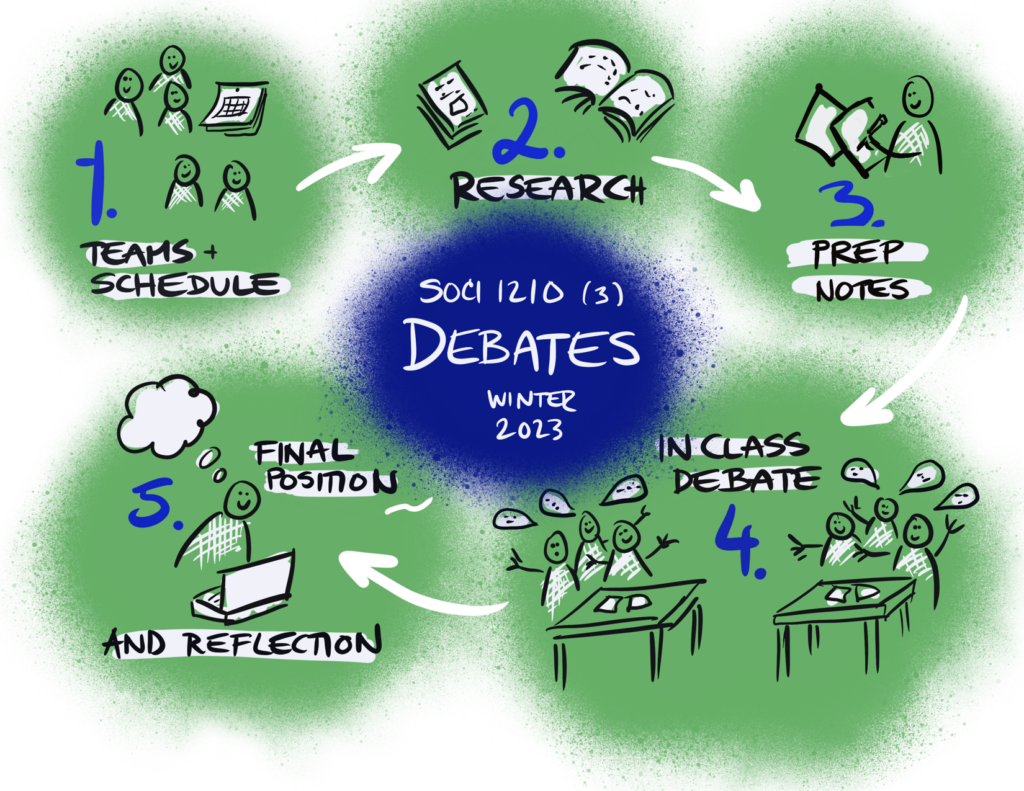
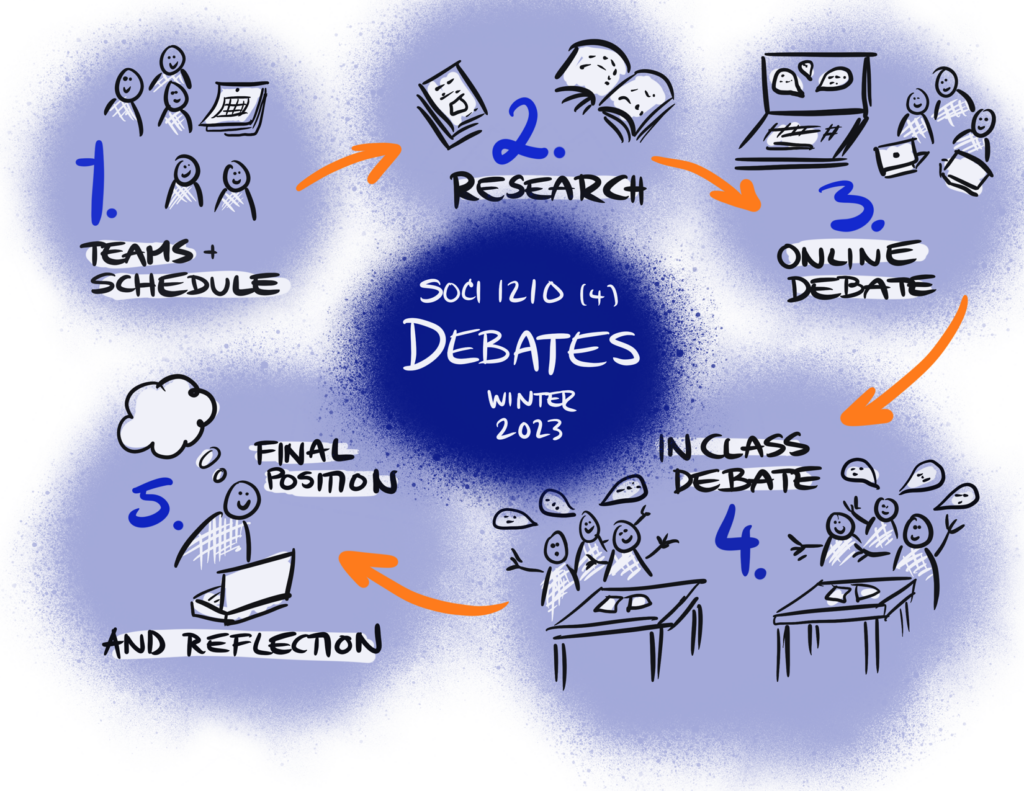
All students had to complete five stages: 1) form teams, 2) research their topics, 3) Prepare notes or participate in an online debate (asynchronous discussion forum), 4) debate in-class, and 5) write a reflection.
The main difference was that section 3 students prepared individual preparation notes, then debated in-class, while Section 4 students debated online first, then in-class.
Phase 1 Preliminary Analysis and Findings
Students achieved higher grades for the debate activity in Section 4 (multimode).
Student Experience Survey Results:
Data was collected through Moodle Feedback Tool.
Student answers about the in-class debate were quite similar or the same in both sections:
- The classroom debate made me think more about my debate topics – Yes, Section 3: 88%, Section 4: 92%
- The classroom debate made me see my topic from multiple perspectives – Yes, both 92%
- The classroom debate had me questioning concepts in new ways – Yes, both 88%
- The classroom debate made me see my topic from multiple perspectives – Yes, both 92%
- The classroom debate had me questioning concepts in new ways – Yes, both 88%
Interpretation: This may indicate that modality is not very influential for critical thinking
Student answers about the preparation notes vs. online debate showed less similarities:
- The classroom debate challenged my initial thoughts and perspectives – Section 3 single mode 92%, Section 4 multimode 80%
- The prep note/online debate challenged my initial thoughts & perspectives – Section 3 single mode 71%, Section 4 multimode 92%
- The prep note/online debate made me see my topic from multiple perspectives – Section 3 single mode 83%, Section 4 multimode 100%
Interpretation: Section 4 multimode students were engaging critical thinking skills during the online debate more than Section 3 single mode students during the preparation note stage. The level of critical thinking could have been increased by the exposure to peer, academically supported arguments during the online debate, more so than during the individually prepared preparation notes (although students also provided scholarly evidence for both sides of the argument). Here the factor of peer, group rather than individual approach could have influenced the data.
The preliminary findings show that students most exercised their critical thinking skills at different stages: the Section 4 multimode students during both the online and in-class debates, and Section 3 single mode students during the in-class debate. We could propose that if we design the debate activity as multimode, students’ critical thinking skill growth is scaffolded better throughout the learning experience. The multimode scaffolding also seems to prepare the students better for the in-class debate and is more enjoyable, as seen next.
Enjoyment: